Temporary utilities maintain operational continuity during planned facility shutdowns, HVAC overhauls, and weather disruptions along the Interstate 40 and Business 85 corridors. A 20-kilowatt mobile generator supports…
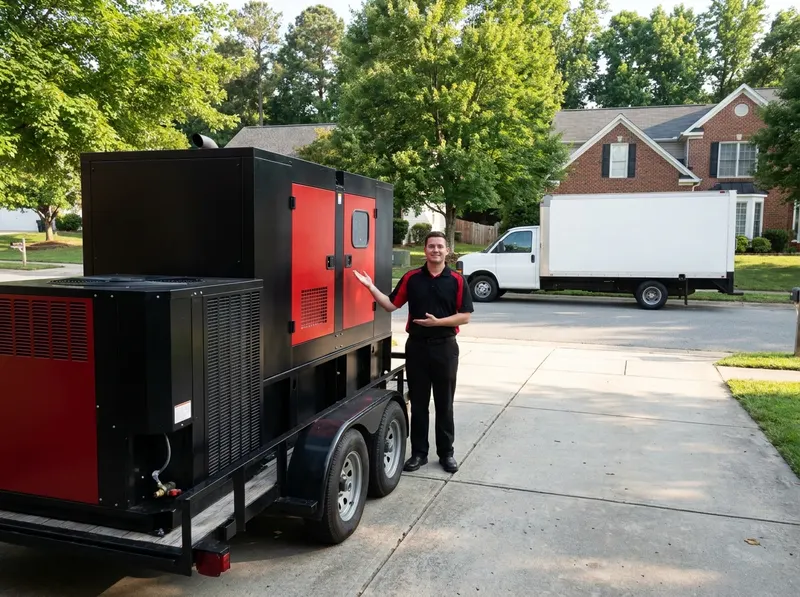
Temporary utilities maintain operational continuity during planned facility shutdowns, HVAC overhauls, and weather disruptions along the Interstate 40 and Business 85 corridors. A 20-kilowatt mobile generator supports standard trailer offices and essential hand-tool power, whereas industrial facilities near West Wendover Avenue or storage depots require 70-kilowatt to 150-kilowatt tier-4 diesel units to power three-phase equipment and large-scale dehumidifiers. For heating during mid-winter concrete pours or structural drying in historic masonry properties throughout Westerwood and Fisher Park, direct-fired heaters deliver immediate high-volume thermal output, whereas closed indoor environments require indirect-fired ducting to prevent carbon monoxide buildup and relative humidity spikes. In contrast, summer humidity drops efficiency rapidly during interior commercial renovations near the Greensboro Coliseum Complex and UNCG, making 1-ton to 5-ton portable air conditioning carts necessary to manage internal ambient temperatures without straining building electrical systems.
Selecting temporary cooling or power requires balancing localized footprint against runtime capacity. A 5-ton portable air conditioner draws roughly 40 amps on a 208/230-volt circuit and lowers high-load server rooms or Lindley Park retail footprints by 15 to 20 degrees Fahrenheit, but requires adequate drop-ceiling plenum or window ducting routes to exhaust hot condenser air. If a job site lacks tie-in access to municipal utility panels, pairing the cooling footprint with an external towable generator solves the power supply issue directly, though it introduces daily fuel monitoring requirements. Ground-protection mats protect finished asphalt and parking pads at Adams Farm commercial plazas and Hamilton Lakes offices, preventing structural surface rutting and fluid staining from heavy trailer tongues.
Staged deployments follow a three-step logistical plan to eliminate worksite downtime. Step 1: Technicians calculate total connected wattage, motor start-up surges, and CFM airflow requirements. Step 2: The delivery transport places the skid or trailer mount on pre-laid heavy composite track mats to safeguard curbs and parking lots, then completes cam-lock or whip terminations according to NFPA 70 guidelines. Step 3: Technicians conduct baseline load-bank testing or thermal run checks before handing off the daily operations log.
Every job gets a firm, written price after a free on-site visit.
Tell us about your commercial climate control and generator rentals job in Greensboro and we'll send a clear, written quote, usually the same day.
 Pine Bluff Dumpster Rental