Nighttime infrastructure operations along the urban corridors of Greensboro demand consistent, glare-controlled ground lighting that satisfies OSHA standard 1926.56 minimum illumination requirements of 5 foot-candles…
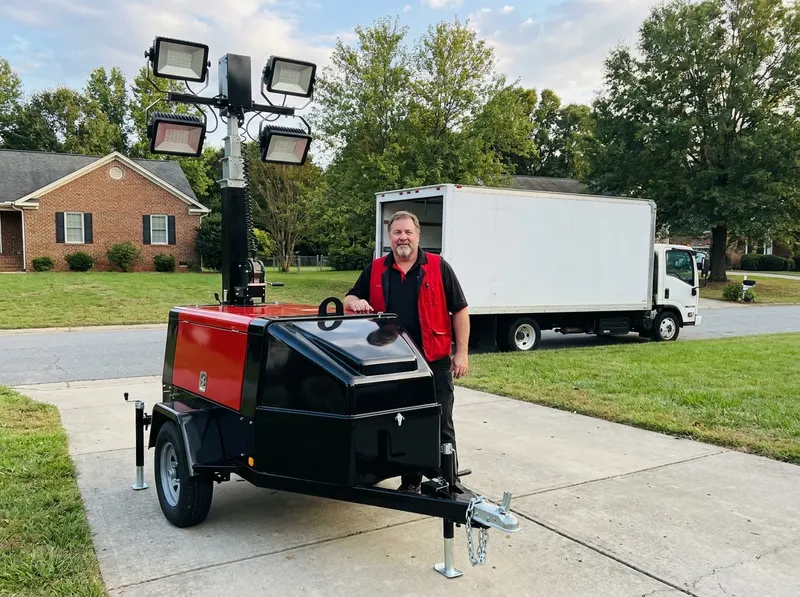
Nighttime infrastructure operations along the urban corridors of Greensboro demand consistent, glare-controlled ground lighting that satisfies OSHA standard 1926.56 minimum illumination requirements of 5 foot-candles for general construction. For commercial paving along Wendover Avenue, athletic staging near the Greensboro Coliseum Complex, or private historic renovations in Fisher Park and Old Irving Park, portable towers supply illumination across a 300-foot radius without requiring permanent utility tie-ins. Standard diesel units carry 30 to 50-gallon fuel tanks that deliver 50 to 70 hours of continuous runtime before refueling, while low-emission solar-hybrid units accommodate quiet residential hours in Westerwood and Sunset Hills.
Selecting between a 4-lamp 1,000-watt metal-halide rig and an 800-watt to 1,200-watt commercial LED tower depends on immediate thermal output, electrical draw, and run duration. Metal-halide fixtures require a 10 to 15-minute strike and restrike window, generating an omnidirectional arc suited for broad parking zones in Starmount Forest or open acreage in Adams Farm, yet their higher power requirement burns roughly 0.5 to 0.75 gallons of diesel per hour. Modern LED arrays offer instant ignition without warm-up delays, cut diesel fuel consumption down to roughly 0.2 to 0.35 gallons per hour, and direct targeted beam patterns downward to eliminate light trespass into adjacent residential windows near Lindley Park and Hamilton Lakes.
Safe installation requires evaluating site surface stability and overhead obstructions before hoisting the telescoping steel mast. Deployment crews position wheel chocks, lower the tongue jack, and extend all 4 outriggers to establish a level footprint capable of withstanding 55 to 65 mph wind gusts before raising the tower to its maximum 30-foot pin stop. Towable light tower rentals function strictly as stationary, trailer-mounted utility equipment dropped at a designated pad; unlike permanent high-mast electrical installations, the customer manages daily engine cycling, routine fluid checks, and safe positioning away from live overhead utility lines on municipal easements.
Every job gets a firm, written price after a free on-site visit.
Tell us about your towable light tower rentals job in Greensboro and we'll send a clear, written quote, usually the same day.
 Pine Bluff Dumpster Rental