Ground conditions across central North Carolina dictate specific machinery choices. Greensboro sits on heavy Cecil soil, an abrasive red clay that turns slick when wet and solidifies into dense brick when dried under…
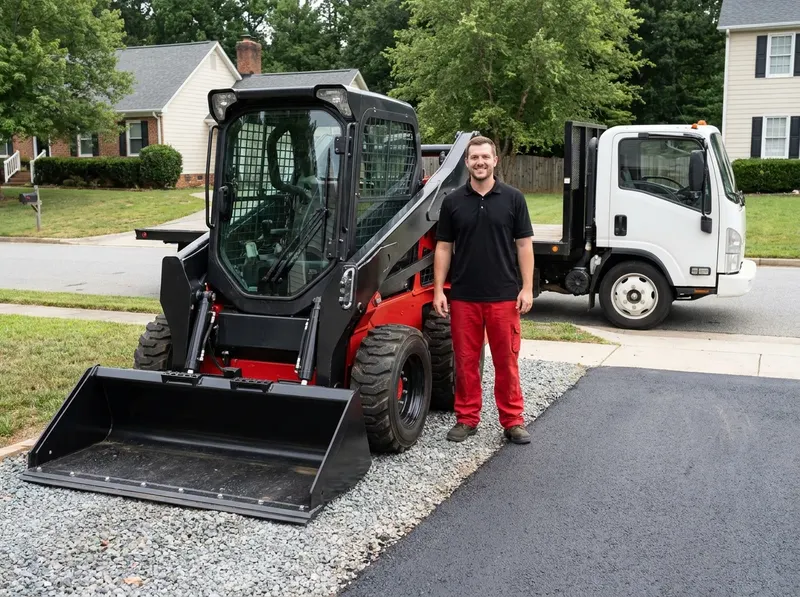
Ground conditions across central North Carolina dictate specific machinery choices. Greensboro sits on heavy Cecil soil, an abrasive red clay that turns slick when wet and solidifies into dense brick when dried under summer heat. Excavating footings near Westerwood or re-grading backyards in Starmount Forest requires high breakout force that standard consumer tools cannot achieve. For residential properties with standard 36-inch walk gates, such as historic lots in Fisher Park or tight backyards in Lindley Park, a walk-behind mini track loader fits narrow property lines while delivering 1,000 lbs of operating capacity. If an operator selects a full-size 8,500-lb compact excavator for a home foundation in Sunset Hills instead of a 3,500-lb zero-tail-swing unit, the trade-off is higher bucket capacity against severe ground compaction and limited turn clearance near mature hardwood canopies.
Ground protection remains an essential logistical operational requirement. Heavy rubber tracks disperse ground pressure to roughly 4.2 pounds per square linear inch, yet crossing finished asphalt or heritage brick borders in Old Irving Park and Hamilton Lakes requires hardwood or composite track matting to prevent edge shear. A 6,000-lb skid steer turning sharply on hot asphalt will grind away aggregate coatings. To protect concrete slabs from cracking under gross operational weights, staging mats distribute point loads over wider spans. Deliveries navigating neighborhood entryways in Adams Farm require 10-foot overhead clearance beneath low-hanging oak limbs and adequate curb radius for an equipment transport trailer to park and ramp down safely.
Rental logistics follow three transparent operational steps. Step 1: Call 811 for NC811 utility locating at least three full working days prior to earth disturbance to mark underground electrical, water, and gas mains. Step 2: Clear an unobstructed drop lane measuring at least 12 feet wide on the driveway or street apron, staging heavy boards if driving over lawn edges. Step 3: Inspect operational fluid levels, track tension, and hydraulic quick-couplers upon trailer drop, ensuring controls match familiar ISO or SAE operational patterns before ground engagement begins.
Every job gets a firm, written price after a free on-site visit.
Tell us about your earthmoving equipment rentals job in Greensboro and we'll send a clear, written quote, usually the same day.
 Pine Bluff Dumpster Rental